Veena
Veena, also known as Saraswati Veena is a musical instrument of South India. This classical instrument is basically a plucked stringed instrument that is used to accompany Carnatic music. It is essentially a member of the lute family. The Veena has been modified and refined over centuries and has been used since ancient times. The Saraswati Veena was created in the south of India during the 17th century. Given below is more information about the classical instrument Veena.
The Veena is an instrument and is shown being played by Goddess Saraswati. That is how it derives the name "Saraswati Veena". Popular variations of the Veena are Rudra Veena, Mahanataka Veena, Vichitra Veena and Gottuvadhyam Veena. The Veena has been a very popular instrument with most singers and there are many famous Veena players who have played some great compositions. Some famous Veena players are listed below.
Famous Veena Players
Doraiswamy Iyengar
Jayanthi Kumaresh
Kalpakam Swaminathan
N. Muralikrishnan
N. Ravikiran
S. Balachander
S.V. Venkateshiah
Veena Dhanammal
Veena Venkatagiriappa
Veene Sheshanna
SITAR
The sitar (Hindi: सितार, Bengali: সেতার, Urdu: ستار, Persian: سه تار ) is a plucked stringed instrument predominantly used in Hindustani classical music Hindustani Sangeet, where it has been ubiquitous since the Middle Ages. It derives its resonance from sympathetic strings, a long hollow neck and a gourd resonating chamber.
Sitar is of the most popular music instruments of North India. The Sitar has a long neck with twenty metal frets and six to seven main cords. Below the frets of Sitar are thirteen sympathetic strings which are tuned to the notes of the Raga. A gourd, which acts as a resonator for the strings is at the lower end of the neck of the Sitar. The frets are moved up and down to adjust the notes. Some famous
Sitar players are Ustad Vilayat Khan, Pt. Ravishankar, Ustad Imrat Khan, Ustad Abdul Halim Zaffar Khan, Ustad Rais Khan and Pt Debu Chowdhury.
SAROD
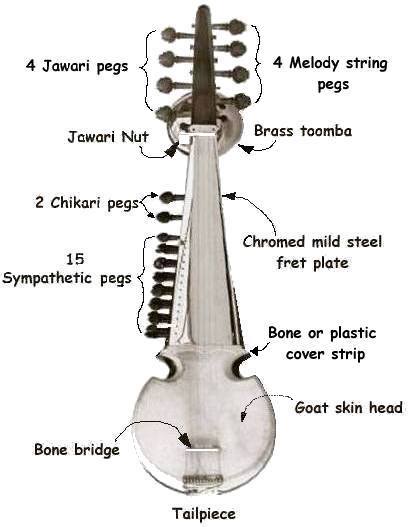
The sarod is a stringed musical instrument, used mainly in Indian classical music. Along with the sitar, it is the most popular and prominent instrument in Hindustani (northern Indian) classical music. The sarod is known for a deep, weighty, introspective sound (contrast with the sweet, overtone-rich texture of the sitar) with sympathetic strings that give it a resonant, reverberant quality. It is a fretless instrument able to produce the continuous slides between notes known as meend (glissandi), which are very important to Indian music.
Sarod has a small wooden body covered with skin and a fingerboard that is covered with steel. Sarod does not have a fret and has twenty-five strings of which fifteen are sympathetic strings. A metal gourd acts as a resonator. The strings are plucked with a triangular plectrum. Some notable exponents of Sarod are Ustad Ali Akbar Khan, Ustad Amjad Ali Khan, Pt. Buddhadev Das Gupta, Zarin Daruwalla and Brij Narayan.
The sarode family or granas or household as we know them today all have their roots in the Afghan rubab with a considerable Seni influence. About 300 years ago, three or four equestrians from Afghanistan migrated to India. One of them was Ghulam Bandegi Khan of Bangash, a soldier and rubab player. He trained his grandson, Ghulam Ali in the art of rubab playing. Ghulam Ali, who became court musician at Gwalior, also received musical training from seni rubab players who were direct descendants of Tansen the Afghan traveler. Ghulam Ali had 3 sons, Hussain Ali, Murad Ali and Nanhe Khan, all of whom were rubab players. Two of the prevalent Family today, from Nanhe Khan and Murad Ali Khan can be attributed directly to Ghulam Ali.
The Afghan rubab players were inducted into Tansen's musical training particularly through their discipleships with important Seni ustads, who were beenkars and dhrupadiyas. The Afghans naturally wanted to translate dhrupad into their instrument. Their rubab used to have catgut strings and the fingerboard was made of wood. The inherent lack of resonance did not facilitate the long glides that emulate the slow movements of vocal music. This led to the evolution of the sarode, which developed, on a host of vocabulary of plucking of different kinds (a la the Afghan rubab) for the right hand as well as the long glides for the left hand. But the finishing touches to the sarode were given by somebody belonging to a totally different family of music, as recently as 60 years ago - Ustad Allauddin Khan.
From Ghulam Ali's youngest son, Nanhe Khan descended Hafiz Ali. Hafiz Ali Khan's musical education took place under the tutelage of Ustad Wazir Khan of Rampur who was the leading representative of the Seni Beenkar family of music in the last century. Hafiz Ali's son Amjad Ali Khan is one of the most accomplished Sarode players of the present day and the family represents one of the oldest surviving sarode family. The Gwalior family of music is also referred to as Seni-Bangash today.
SARANGI
Standard Tuning - The most common approach to tuning the sarangi is shown below:
There are a number of different sets of strings. There are three playing strings, one dronerag.string and two sets of sympathetic strings. The tuning of Sa, lower Pa, and low Sa, would be the most basic for the main playing strings. The drone string will usually be tuned to Sa, but even Ma or Pa is frequently found. The tunings of the sympathetic strings are so numerous that it is impractical to even attempt to describe them all. However, one normal approach is to tune one bank of the side sympathetics chromatically, the other bank of side strings to the rag, while the upper sympathetics may also be tuned to the notes of the rag.

Sarangi is one of the most popular and oldest bowed instruments in India. The body of Sarangi is hollow and made of teak wood adorned with ivory inlays. Sarangi has forty strings of which thirty seven are sympathetic. The Sarangi is held in a vertical position and played with a bow. To play the Sarangi one has to press the fingernails of the left hand against the strings. Famous Sarangi maestros are Rehman Bakhs, Pt Ram Narayan, Ghulam Sabir and Ustad Sultan Khan.
Flute
Flute is a simple cylindrical tube of uniform bore and associated with Indian music since time immemorial. Flutes vary in size. Flute is held horizontally and is inclined downwards when it is played. To produce sound or melody one has to cover the finger holes with the fingers of the left and right hand. Variations in pitch are produced by altering the effective length of the air column. Notable flute exponents are Pt Pannalal Ghosh and Pt Hari Prashad Chaurasia.
Shehnai
Shehnai is a traditional musical instrument, associated with auspicious occasions like marriages and temple processions. Shehnai is a double reed instrument with a tapering bore which progressively increases towards the lower side. The Shehnai has finger-holes to produce semi, quarter and micro-tones. Ustad Bismillah Khan is the unrivalled maestro of the Shehnai.
Tabla
The most popular musical instrument used in North India is the Tabla. The Tabla consists of a pair of drums- the Tabla and the Bayan. The Tabla is made of wood and whereas its head is made of stretched animal skin. Finer tuning of Tabla is done by striking the rim of the Tabla with a small hammer. The Bayan is the bass drum and is usually made of metal with a stretched skin head. Both drums have a black spot in the center made of manganese or iron dust.
Pakhawaj
It is believed that the Tabla was derived from Pakhawaj. Pakhawaj usually accompanies Dhrupad style of singing. Pakhawaj is a barrel-shaped drum with two heads which are made of layers of skin. The heads of Pakhawaj are expanded by leather straps which run along the sides of the body over small cylindrical wooden blocks that are used for tuning.
Harmonium
The harmonium is a traditional and popular musical instrument of India. The harmonium has a keyboard of over two and one-half octaves and works on a system of bellows. The keyboard is played with the right hand while the left hand is used to operate the bellows. Harmonium is more popular in North India than in the South.
Jaltarangam
Jaltarangam consists of a set of eighteen porcelain cups of varying sizes. The cups are arranged in a semi-circle before the performer, in decreasing order of size. The largest cup is to the left of the performer whereas the smallest to his right. Water is poured into the cups and the pitch is changed by adjusting the amount of water in the cup. The cups are struck with two thin bamboo sticks.
Mridangam
The mridangam is one of the most popular classical instruments of South India. Mridangam accompanies vocal, instrumental and dance performances. The present day mridangam is made of a single block of wood. It is a barrel-shaped double-headed drum, the right head being smaller than the left. The two heads are made of layers of skin. The mridangam is played with hands, palms and fingers.
Ghatam
The Ghatam is one oldest percussion instruments of South India. The Ghatam is a mud pan with a narrow mouth. From its mouth, it slopes outwards to form a ridge. Ghatam is made mainly of clay baked with brass or copper filings with a small amount of iron filings. The Ghatam produces fast rhythmic patterns. Ghatam is generally a secondary percussion instrument accompanying mridangam.