Friday, June 18, 2010

Music Instruments in india

Veena


Veena, also known as Saraswati Veena is a musical instrument of South India. This classical instrument is basically a plucked stringed instrument that is used to accompany Carnatic music. It is essentially a member of the lute family. The Veena has been modified and refined over centuries and has been used since ancient times. The Saraswati Veena was created in the south of India during the 17th century. Given below is more information about the classical instrument Veena. 
The Veena is an instrument and is shown being played by Goddess Saraswati. That is how it derives the name "Saraswati Veena". Popular variations of the Veena are Rudra Veena, Mahanataka Veena, Vichitra Veena and Gottuvadhyam Veena. The Veena has been a very popular instrument with most singers and there are many famous Veena players who have played some great compositions. Some famous Veena players are listed below.
Famous Veena Players
Doraiswamy Iyengar
Jayanthi Kumaresh
Kalpakam Swaminathan
N. Muralikrishnan
N. Ravikiran
S. Balachander
S.V. Venkateshiah
Veena Dhanammal
Veena Venkatagiriappa
Veene Sheshanna
SITAR
The sitar (Hindi: सितार, Bengali: সেতার, Urdu: ستار, Persian: سه تار ) is a plucked stringed instrument predominantly used in Hindustani classical music Hindustani Sangeet, where it has been ubiquitous since the Middle Ages. It derives its resonance from sympathetic strings, a long hollow neck and a gourd resonating chamber.
   Sitar is of the most popular music instruments of North India. The Sitar has a long neck with twenty metal frets and six to seven main cords. Below the frets of Sitar are thirteen sympathetic strings which are tuned to the notes of the Raga. A gourd, which acts as a resonator for the strings is at the lower end of the neck of the Sitar. The frets are moved up and down to adjust the notes. Some famous
  Sitar players are Ustad Vilayat Khan, Pt. Ravishankar, Ustad Imrat Khan, Ustad Abdul Halim Zaffar Khan, Ustad Rais Khan and Pt Debu Chowdhury.


SAROD
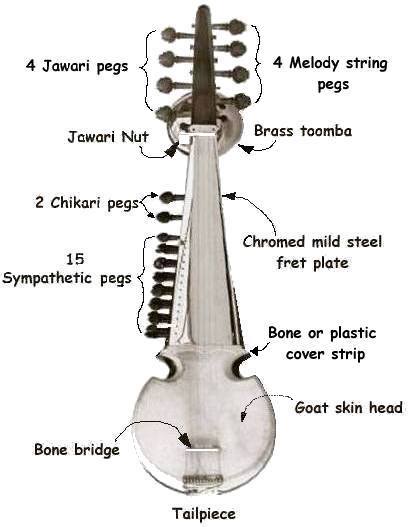
 The sarod is a stringed musical instrument, used mainly in Indian classical music. Along with the sitar, it is the most popular and prominent instrument in Hindustani (northern Indian) classical music. The sarod is known for a deep, weighty, introspective sound (contrast with the sweet, overtone-rich texture of the sitar) with sympathetic strings that give it a resonant, reverberant quality. It is a fretless instrument able to produce the continuous slides between notes known as meend (glissandi), which are very important to Indian music.
Sarod has a small wooden body covered with skin and a fingerboard that is covered with steel. Sarod does not have a fret and has twenty-five strings of which fifteen are sympathetic strings. A metal gourd acts as a resonator. The strings are plucked with a triangular plectrum. Some notable exponents of Sarod are Ustad Ali Akbar Khan, Ustad Amjad Ali Khan, Pt. Buddhadev Das Gupta, Zarin Daruwalla and Brij Narayan.

Th
e sarode family or granas or household as we know them today all have their roots in the Afghan rubab with a considerable Seni influence. About 300 years ago, three or four equestrians from Afghanistan migrated to India. One of them was Ghulam Bandegi Khan of Bangash, a soldier and rubab player. He trained his grandson, Ghulam Ali in the art of rubab playing. Ghulam Ali, who became court musician at Gwalior, also received musical training from seni rubab players who were direct descendants of Tansen the Afghan traveler. Ghulam Ali had 3 sons, Hussain Ali, Murad Ali and Nanhe Khan, all of whom were rubab players. Two of the prevalent Family today, from Nanhe Khan and Murad Ali Khan can be attributed directly to Ghulam Ali.

The Afghan rubab players were inducted into Tansen's musical training particularly through their discipleships with important Seni ustads, who were beenkars and dhrupadiyas. The Afghans naturally wanted to translate dhrupad into their instrument. Their rubab used to have catgut strings and the fingerboard was made of wood. The inherent lack of resonance did not facilitate the long glides that emulate the slow movements of vocal music. This led to t
he evolution of the sarode, which developed, on a host of vocabulary of plucking of different kinds (a la the Afghan rubab) for the right hand as well as the long glides for the left hand. But the finishing touches to the sarode were given by somebody belonging to a totally different family of music, as recently as 60 years ago - Ustad Allauddin Khan.

From Ghulam Ali's youngest son, Nanhe Khan descended Hafiz Ali. Hafiz Ali Khan's musical education took place under the tutelage of Ustad Wazir Khan of Rampur who was the leading representative of the Seni Beenkar family of music in the last century. Hafiz Ali's son Amjad Ali Khan is one of the most accomplished Sarode players of the present day and the family represents one of the oldest surviving sarode family. The Gwalior family of music is also referred to as Seni-Bangash today.


SARANGI
Standard Tuning - The most common approach to tuning the sarangi is shown below:
There are a number of different sets of strings.  There are three playing strings, one dronerag.string and two sets of sympathetic strings.  The tuning of Sa, lower Pa, and low Sa, would be the most basic for the main playing strings.  The drone string will usually be tuned to Sa, but even Ma or Pa is frequently found.  The tunings of the sympathetic strings are so numerous that it is impractical to even attempt to describe them all.  However, one normal approach is to tune one bank of the side sympathetics chromatically, the other bank of side strings to the rag, while the upper sympathetics may also be tuned to the notes of the rag.

  Sarangi is one of the most popular and oldest bowed instruments in India. The body of Sarangi is hollow and made of teak wood adorned with ivory inlays. Sarangi has forty strings of which thirty seven are sympathetic. The Sarangi is held in a vertical position and played with a bow. To play the Sarangi one has to press the fingernails of the left hand against the strings. Famous Sarangi maestros are Rehman Bakhs, Pt Ram Narayan, Ghulam Sabir and Ustad Sultan Khan.

Flute

Flute is a simple cylindrical tube of uniform bore and associated with Indian music since time immemorial. Flutes vary in size. Flute is held horizontally and is inclined downwards when it is played. To produce sound or melody one has to cover the finger holes with the fingers of the left and right hand. Variations in pitch are produced by altering the effective length of the air column. Notable flute exponents are Pt Pannalal Ghosh and Pt Hari Prashad Chaurasia.

Shehnai

Shehnai is a traditional musical instrument, associated with auspicious occasions like marriages and temple processions. Shehnai is a double reed instrument with a tapering bore which progressively increases towards the lower side. The Shehnai has finger-holes to produce semi, quarter and micro-tones. Ustad Bismillah Khan is the unrivalled maestro of the Shehnai.

Tabla

The most popular musical instrument used in North India is the Tabla. The Tabla consists of a pair of drums- the Tabla and the Bayan. The Tabla is made of wood and whereas its head is made of stretched animal skin. Finer tuning of Tabla is done by striking the rim of the Tabla with a small hammer. The Bayan is the bass drum and is usually made of metal with a stretched skin head. Both drums have a black spot in the center made of manganese or iron dust.

Pakhawaj
It is believed that the Tabla was derived from Pakhawaj. Pakhawaj usually accompanies Dhrupad style of singing. Pakhawaj is a barrel-shaped drum with two heads which are made of layers of skin. The heads of Pakhawaj are expanded by leather straps which run along the sides of the body over small cylindrical wooden blocks that are used for tuning.

Harmonium

The harmonium is a traditional and popular musical instrument of India. The harmonium has a keyboard of over two and one-half octaves and works on a system of bellows. The keyboard is played with the right hand while the left hand is used to operate the bellows. Harmonium is more popular in North India than in the South.

Jaltarangam

Jaltarangam consists of a set of eighteen porcelain cups of varying sizes. The cups are arranged in a semi-circle before the performer, in decreasing order of size. The largest cup is to the left of the performer whereas the smallest to his right. Water is poured into the cups and the pitch is changed by adjusting the amount of water in the cup. The cups are struck with two thin bamboo sticks.

Mridangam

The mridangam is one of the most popular classical instruments of South India. Mridangam accompanies vocal, instrumental and dance performances. The present day mridangam is made of a single block of wood. It is a barrel-shaped double-headed drum, the right head being smaller than the left. The two heads are made of layers of skin. The mridangam is played with hands, palms and fingers.

Ghatam
The Ghatam is one oldest percussion instruments of South India. The Ghatam is a mud pan with a narrow mouth. From its mouth, it slopes outwards to form a ridge. Ghatam is made mainly of clay baked with brass or copper filings with a small amount of iron filings. The Ghatam produces fast rhythmic patterns. Ghatam is generally a secondary percussion instrument accompanying mridangam.

Maharashtra Traditional Costume

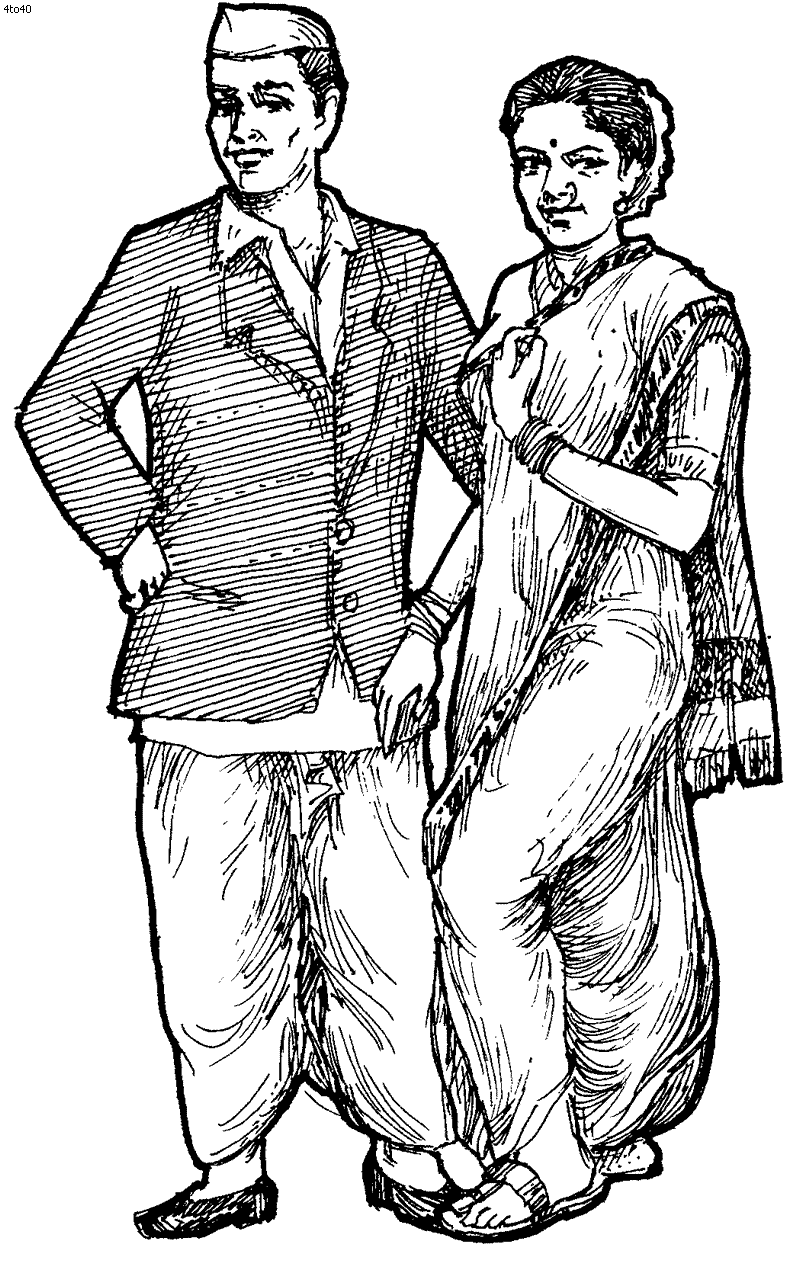
It can be said that costumes of Maharashtra truly reflect the identity of a typical Maharashtrian culture. A nine yard sari is a traditional costume of its women, and dhoti and shirt is the traditional costume of its men folk. Maharashtra has a vast textile history, which has contributed to its rich variety of costumes. Pune, Paithan and Kolhapur are some of the ideal places to shop for typical Maharashtrian clothing.

Saturday, May 1, 2010

Tirupati - Heaven of Tranquility

Tirupati
 Heaven of Tranquility
 
Tranquillity (also spelled tranquility) is the quality of calm experienced in places with mainly natural features and activities, free from disturbance from man-made areas.
 References to Tiruvenkatam abound in early Tamil literature(Tolkappiam and Silappadikaram)
Tirupati/Tirumala is a pilgrimage center of great significance and is visited by hundreds of thousands of pilgrims throughout the year.Tirupati balaji is also known as Venkateswara, or Srinivasa or Vishnu for many year's and it was located on a range of the Eastern Ghats, called the Seven Hills.It is an ancient temple and its glory has been sung by the saints of the yesteryears.
The richest temple in India, this temple is a vibrant cultural and philanthropic institution with a grand history spanning several centuries.  
The best time to vist tirupati in October to March
How to reach Tirupati Temple:
BY AIR:- Tirupati is 15 kms from the city centre and the Indian Airlines office is situated at the Hotel Vishnupriya, opposite the central bus terminal. East - West Airlines has four flights a week to Hyderabad (Saturday, Sunday, Tuesday and Thursday) and other flights to and from Chennai.
BY TRAIN:-There are two trains that connect Tirupati with Chennai - the Saptagiri Express and the Tirupati - Madras Mail. 
BY BUS:- The government bus stand, APSRTC Central bus station is about 2 kms away from the railway station. Express buses are available to and from Chennai to Tirupati. From Tirupati you can take direct buses to Hyderabad, Tiruchirappalli, Madurai, Vellore and Vijayawada and Bangalore.

Bhakt Darshan
For tourist purpose only the government had provided ahe Dharamshalas, located near the temple complex at cheap rate
The famous hotels and lodges of the town are New Bhimas House, Bhimas Paradise, The Bhimas Hotel, Indira Rest House, Vasantha Vihar Lodge, Gopi Krishna Deluxe Hotel, Hotel Vishnu Priya, Hotel Mayura, Oorvasi International Hotel, Raghunadha etc.

Friday, April 23, 2010

Life Story of Shirdi Sai Baba

 
Shirdi is located in Ahmednagar district of Maharashtra in Western India. Shirdi extends latitude 19°45 N and longitude 74°25 E..
Shirdi is quite close to the holy city of Nashik with just 90kms away. It takes about 6hrs to reach Saibaba of Shirdi from Mumbai. Pune is about 206kms from Shirdi.
Here is brief distance chart of Shirdi from some important cities of Maharashtra:
Mumbai 266 kms
Nasik 90 kms
Hyderabad 610 kms
Surat 373 kms
Nagpur 618 kms
Jalgaon 233 kms
Ahmednagar 83 kms
Aurangabad 144 kms
Delhi 1166 kms
Pune 207 kms
Sholapur 312 kms
Sai Baba of Shirdi (Unknown – October 15, 1918), also known as Shirdi Sai Baba (Marathi: शिरडीचे साईबाबा, Hindi: शिरडीके साईबाबा, Telugu: షిర్డీ సాయి బాబా), was an Indian guru, yogi and fakir who is regarded by his Hindu and Muslim followers as a saint. Some of his Hindu devotees believe that he was an incarnation of ShivaDattatreya. Many devotees believe that he was a Sadguru. There are many stories and eyewitness accounts of miracles he performed. He is a well-known figure in many parts of the world, but especially in India, where he is much revered.
Life Story of Shirdi Sai Baba
 

On September 29, 1990
In the former Nizam's [Maharaj] dominion, there was a remote village called Pathri. In that village there were a couple named Gangabhavadya and Devagiriamma. They were grieving over the lack of children. In answer to their prayers, a son was born on September 28, 1835. Today is the anniversary of that day. This child was Sai Baba. As Gangabhavadya had developed a feeling of total detachment and renunciation, he decided to retire to a forest regardless of the child. Devagiriamma, who looked upon her husband as God, decided to follow the husband leaving the child.

Thursday, April 22, 2010

Khajuraho - Temples of Love in India

Khajuraho - Temples of Love in India
The name Khajuraho, ancient "Kharjuravahaka", is derived from the Sanskritkharjur meaning date palm. word
The Khajuraho Group of Monuments in Khajuraho (Hindi: खजुराहो), a town in the Indian state of Madhya Pradesh, located in Chhatarpur District, about 620 kilometres (385 mi) southeast of New Delhi, are one of the most popular tourist destinations in India. Khajuraho has the largest group of medieval HinduJain temples, famous for their erotic sculpture. The Khajuraho group of monuments has been listed as a UNESCO World Heritage Site and , and is considered to be one of the "seven wonders" of India.
Khajuraho derives its name from the Khajur tree (the date palm tree) which abound a plenty in the region.The construction of these temples began in the reign of King Yasovarman. Eighty five of these temples were built of which around twenty two survive today. These temples are divided into three geographical blocks: the western, eastern and the southern. The western block is the biggest and the richest in artistry. 
Khajuraho Temples are the most graphic, erotic and sensuous sculptures of India, the world has ever known. But Khajuraho has not received the attention it deserves for its significant contribution to the religious art of India – there are literally hundreds of exquisite images on the interior and exterior walls of the shrines. 
Architecturally these temples are unique. While each temple in Khajuraho has a distinct plan and design, several features are common to all. They are all built on high platforms, several metres off the ground, either in granite or a combination of light sandstone and granite. Each of these temples has an entrance hall or mandapa, and a sanctum sanctorum or garbha griha. The roofs of these various sections have a distinct form. The porch and hall have pyramidal roofs made of several horizontal layers. The inner sanctum's roof is a conical tower - a colossal pile of stone (often 30m high) made of an arrangement of miniature towers called shikharas. 
Major Groups of Khajuraho Temples
For the purpose of convenience, the village of Khajuraho has been divided into three directional areas in which are located the major groups of temples .  

1- Western Group Temples
These groups of Khajuraho temples are entirely Hindu, and constitute some of the finest examples of Chandela art at its peak. The largest being the Kandhariya Mahadev, followed by a granite temple - Chaunsath Yogini. The Chitragupta Temple is dedicated to the Sun God, while the Vishwanath Temple sports a three-headed image of Brahma – the Creator of the Universe. The Lakshmana Temple is superbly decorated, while the Devi Jagdambi Temple is dedicated to Goddess Kali. Other temples in the Western Group include the Varaha Temple with a nine-feet high boar-incarnation of Lord Vishnu, the Matangeshwara Temple with a eight-feet high lingam, and the Brahma Temple.
2- Eastern Group Temples
This group of Khajuraho tempels comprises of two historic Jain temples – the Adinath Temple lavishly embellished with sculpted figures, and the Parsvanath Temple, the largest Jain temple, sculpted with charming detail. There are other shrines such as the Vamana Temple with apsaras in sensuous poses, and the Javari Temple that has a richly-carved doorway.
3-Southern Group
This group has two impressive Khajuraho temples, mainly belonging to the 12th century – the Chaturbhuja Temple, with a massive, carved image of Vishnu, and the Duladeo Temple, one of the last temples of the Chandela era, dedicated to Lord Shiva.
Khajuraho Hotels
5 star hotels
Jass Trident
Hotel Chandela

3 star hotel
Hotel Khajuraho Ashok
Usha Bundela
Kairali Ayurvedic Health Spa

Wednesday, April 21, 2010

Tajmahal-The Symbol Of Love

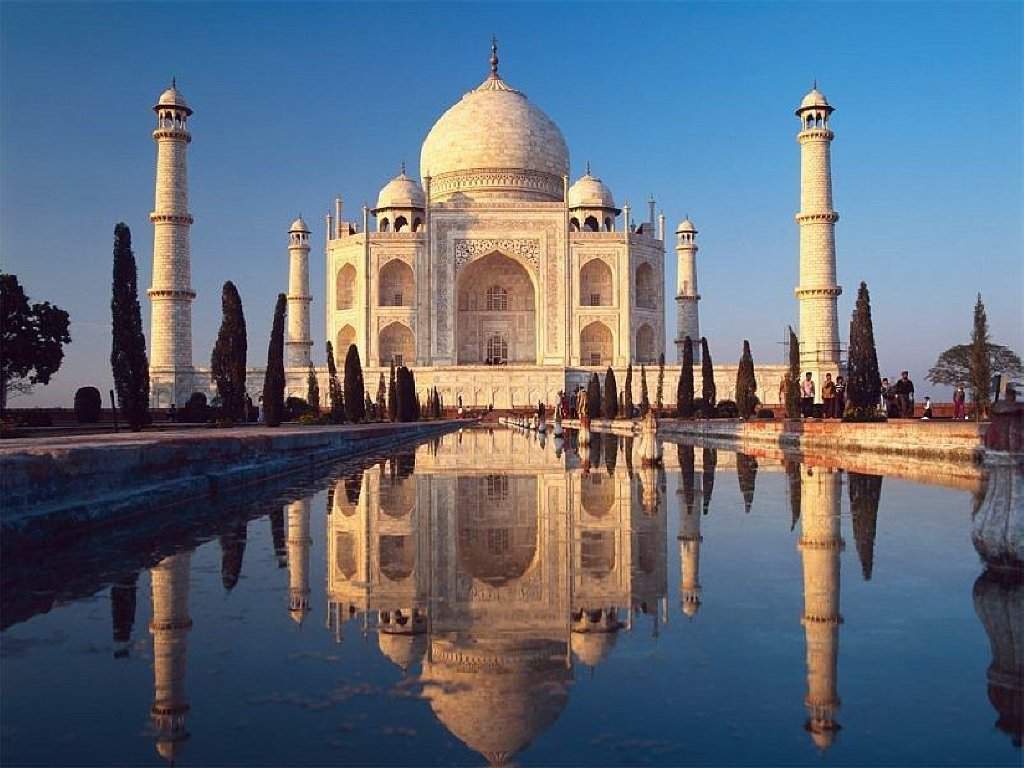
The Taj Mahal is an immense mausoleum of white marble, built between 1631 and 1648 by order of the Mughal emperor Shah Jahan in memory of his favourite wife. Taj Mahal means Crown Palace; one of the wife's names was Mumtaz Mahal, Ornament of the Palace. The Taj is one of the most well preserved and architecturally beautiful tombs in the world, one of the masterpieces of Indian Muslim architecture, and one of the great sites of the world's heritage.  
The Taj Mahal stands serene and perfect in its garden of cypresses and reflecting pools on the banks of the River Yamuna. Its pure white marble shimmers silvery white in the moonlight, glows softly pink at dawn, and at close of day reflects the fiery tints of the setting sun. The Taj in all its timeless beauty is still the inspiration of poets and painters, writers and photographers. And lovers still meet here in the moonlight in the shadow of the world's most famous monument to love. Shahjehan built the Taj in memory of Mumtaz Mahal who died giving birth to their 14th child. No cost was spared to make it the most beautiful monument the world had ever seen. White marble and red sandstone, silver and gold, carnelian and jasper, moonstone and jade, lapis lazuli and coral were fashioned by 20, 000 skilled workers to make the emperor's dream a reality. It took 22 years to complete - a symbol of eternal love where Shahjehan too lies buried, re-united at last with his beloved Mumtaz.
Set at the north end of a formal Persian garden with water courses, paved walkways and rows of dark cypresses, the Taj rises on a high red sandstone base topped by a huge white marble terrace, its flawless double dome flanked by four tapering minarets. Within lies the jewel-inlaid cenotaph of the queen, and a little to one side - the only asymmetrical feature in the Taj - the richly decorated casket of the emperor. Both are enclosed by an octagonal screen of finely pierced marble. So perfect are the proportions of the Taj, so exquisite its workmanship, that it has been described as having been designed by giants and finished by jewellers.
The legend, the poetry and the romance that shroud was described by Rabindranath Tagore as "a teardrop on the cheek of time". Taj Mahal means "Crown Palace" and is in fact the most well preserved and architecturally beautiful tomb in the world. It is best described by the English poet, Sir Edwin Arnold, as "Not a piece of architecture, as other buildings are, but the proud passions of an emperor's love wrought in living stones." It is a celebration of woman built in marble and that's the way to appreciate it. Taj Mahal stands on the bank of River Yamuna, which otherwise serves as a wide moat defending the Great Red Fort of Agra, the center of the Mughal emperors until they moved their capital to Delhi in 1637.
The Story of a Taj Mahal
According to popular legend, Shah Jahan decided to construct another Taj Mahal in black marble on the other side of the river Yamuna and to connect the two by a bridge. This structure was intended to be his own tomb. It has been recorded almost contemporarily by a French merchant Tavernier : "Shah Jehan began to build his own tomb on the other side of the river but the war with his sons interrupted his plan and Aurangzeb who reigns at present is not disposed to complete it".
Later gazetteers and guide books mention this story almost invariably. The irregular position of the cenotaph of Shah Jahan as compared to that of Mumtaz Mahal which occupies the exact centre of the hall is said to be proof of this assumption. The Mehtab Burj and the wall adjoining it opposite the Taj Mahal are generally said to be the foundations and remains of the proposed plan.
Many scholars, however, believe that this idea belongs to fiction rather than history. The traces which are identified as the foundations of the second Taj Mahal are actually the enclosing wall of a garden founded by Babar. The irregular position of Shah Jahan's cenotaph in comparison to Mumtaz Mahal's, is similar to that at the tomb of Itmad-ud-Daulah, and thus should not be of any striking significance. Besides, according to Islamic law, bodies are buried with their faces towards Mecca and legs towards the south, and the husband is placed on the right hand side of his wife. The interpretation that the cenotaph of Shah Jahan was not meant to be placed here appears to be superfluous.

Sunday, April 18, 2010

Languages in India with MAP

There are 1652 different languages in India and 350 are as major languages. 
Most of the languages of India belong to two families, Aryan and Dravidian. Languages spoken in the five states of south India belong to the Dravidian family and most of the
languages spoken in the north are of Aryan family. The general script of the Aryan languages is different from the general script of the Dravidian languages. The Indians also distinguish between the general north Indian accent and general south Indian accent. Along with these two main language families, there are others from Sino-Mongoloid family spoken in the East India.
Indian literature dates back several millennia to the hymns of the Vedic Aryans. The oral tradition nurtured classical literature, and produced great works of philosophy and religious doctrine. It also accounted for compilations of anecdotes like the Panchatantra and the Jataka tales, as well as epics like the Ramayana and the Mahabharata. In southern India, the creative energies of the Tamil poets found expression in the great works of Sangam literature. The epic Tirukkural by Tiruvalluvar is a masterpiece of this age. In the north, dramatists like Kalidasa and Bhasa produced great dramas in Sanskrit.
The Constitution has recognized Hindi, in the Devanagiri script, as India's official language. However English continues to be the working language. For many educated Indians, English is virtually their first language, and for a great number of Indians who are multi-lingual, it will probably be the second. The regional languages have been recognized as official languages of the States. In many cases, the state boundaries are drawn along linguistic lines. Listed below are the 22 languages officially recognized by the Indian Constitution. Four of them, namely Bodo, Dogri, Maithili and Santhali, have been recently added to the eighth schedule.

MumbaDevi Temple - Mumbai

MumbaDevi temple is one of the oldest city temples and is said to be the goddess who protects Mumbai city from all natural calamities. ...